Potentially toxic plankton algae may play a crucial role in the future Arctic

As the sea ice shrinks in the Arctic, the plankton community that produces food for the entire marine food chain is changing. New research shows that a potentially toxic species of plankton algae that lives both by doing photosynthesis and absorbing food may become an important player in the Arctic Ocean as the future sea ice becomes thinner and thinner.

Microscopic plankton algae, invisible to the naked eye, are the foundation of the marine food web, feeding all the ocean´s living creatures from small crustaceans to large whales. Plankton algae need light and nutrients to produce food by photosynthesis.

A thick layer of sea ice – sometimes covered with snow – can reduce how much sunlight penetrates into the water and stop the algae getting enough light. However, as the sea ice is becoming thinner and less widespread in the Arctic, more and more light is penetrating into the sea. Does this mean more plankton algae and thus more food for more fish, whales and seabirds in the Arctic? The story is not so simple.

More light in the sea will only lead to a higher production of plankton algae if they also have enough nutrients – and this is often not the case. With the recent increase in freshwater melt from Arctic glaciers and the general freshening of the Arctic Ocean, more and more fresh and nutrient-depleted water is running out into the fjords and further out into the sea. The fresher water lies on top of the more salty ocean and stops nutrients from the deeper layers from mixing up towards the surface where there is light. And it is only here that plankton algae can be active.

Mixotrophic algae play on several strings

However, a new study published in the journal Nature – Scientific Reports shows that so-called mixotrophic plankton algae may play a crucial role in the production of food in the Arctic Sea.

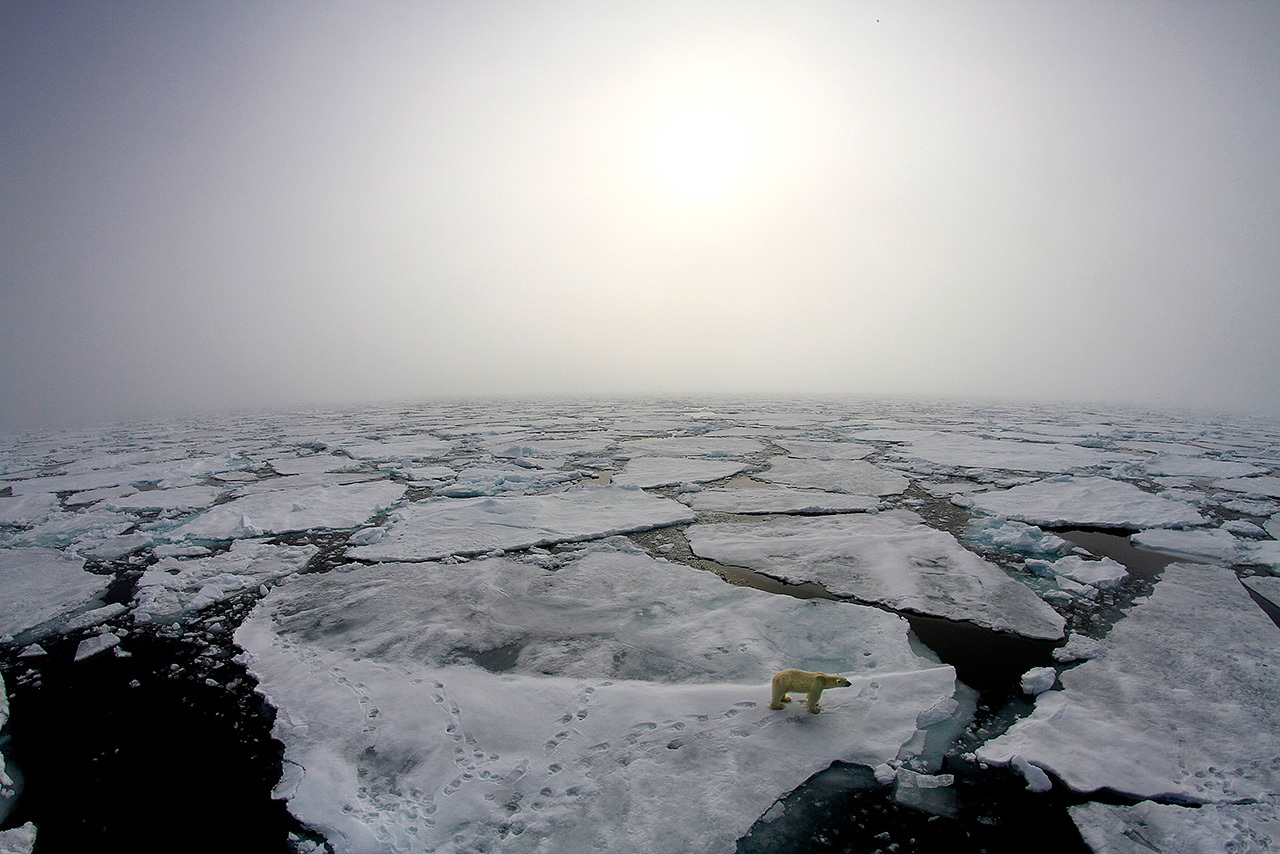
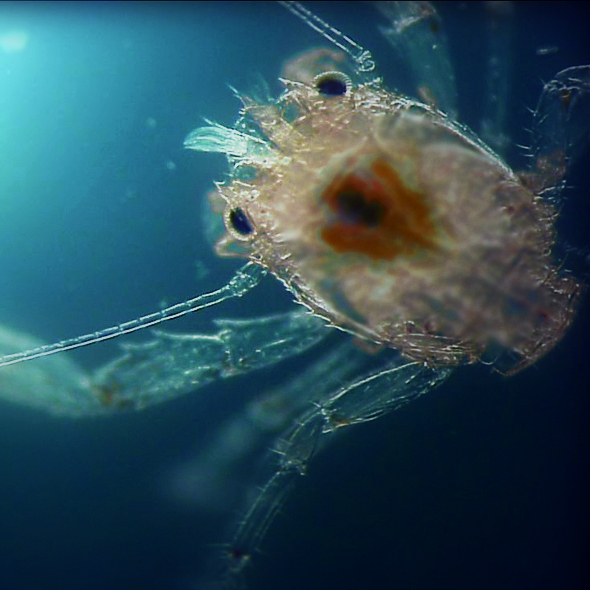
When the spring sets in in the Arctic, the metre-thick sea ice begins to melt. Melt ponds on the surface of the sea ice bring so much sunlight into the underlying seawater that the mixotrophic plankton algae start to grow dramatically. During an approx. 9-day period, the plankton can produce up to half of the total annual pelagic production in the high-Arctic fjord, Young Sound, in northeast Greenland. Several mixotrophic algae species are toxic. Photo credit: Lars Chresten Lund Hansen and Dorte H. Søgaard

Mixotrophic algae are small, single-celled plankton algae that can perform photosynthesis but also obtain energy by eating other algae and bacteria. This allows them to stay alive and grow even when their photosynthesis does not have enough light and nutrients in the water.

In northeast Greenland, a team of researchers measured the production of plankton algae under the sea ice in the high-Arctic fjord Young Sound, located near Daneborg.

“We showed that the plankton algae under the sea ice actually produced up to half of the total annual plankton production in the fjord,” says Dorte H. Søgaard from the Greenland Climate Research Centre, Greenland Institute of Natural Resources and the Arctic Research Centre, Aarhus University, who headed the study.

“Mixotrophic plankton algae have the advantage that they can sustain themselves by eating other algae and bacteria as a supplement to photosynthesis when there isn’t enough light. This means that they are ready to perform photosynthesis even when very little light penetrates into the sea. In addition, many mixotrophic algae can live in relatively fresh water and at very low concentrations of nutrients – conditions that often prevail in the water layers under the sea ice in the spring when the ice melts,” Dorte H. Søgaard explains.

Toxic algae kill fish

For nine days, the researchers measured an algal bloom driven by mixotrophic algae occurring under the thick but melting sea ice in Young Sound during the Arctic spring in July, as the sun gained more power and more melt ponds spread across the sea ice, gradually letting through more light.

The algae belong to a group called haptophytes. Many of these algae are toxic, and in this study they bloomed in quantities similar to those previously observed in the Skagerrak near southern Norway. Here, the toxic plankton algae killed large amounts of salmon in Norwegian fish farms.

“We know that haptophytes often appear in areas with low salinity – as seen in the Baltic Sea, for example. It is therefore very probable that these mixotrophic-driven algae blooms will appear more frequently in a more freshwater-influenced future Arctic Ocean and that this shift in dominant algae to a mixotrophic algae species might have a large ecological and socio-economic impact.” says Dorte H. Søgaard.

The researchers behind the project point out that it is the first time that a bloom of mixotrophic algae has been recorded under the sea ice in the Arctic.

More information: An under-ice bloom of mixotrophic haptophytes in low nutrient and freshwater-influenced Arctic waters.http://www.nature.com/articles/s41598-021-82413-y
Record-high Arctic freshwater will flow to Labrador Sea, affecting local and global oceans

Freshwater is accumulating in the Arctic Ocean. The Beaufort Sea, which is the largest Arctic Ocean freshwater reservoir, has increased its freshwater content by 40% over the past two decades. How and where this water will flow into the Atlantic Ocean is important for local and global ocean conditions.

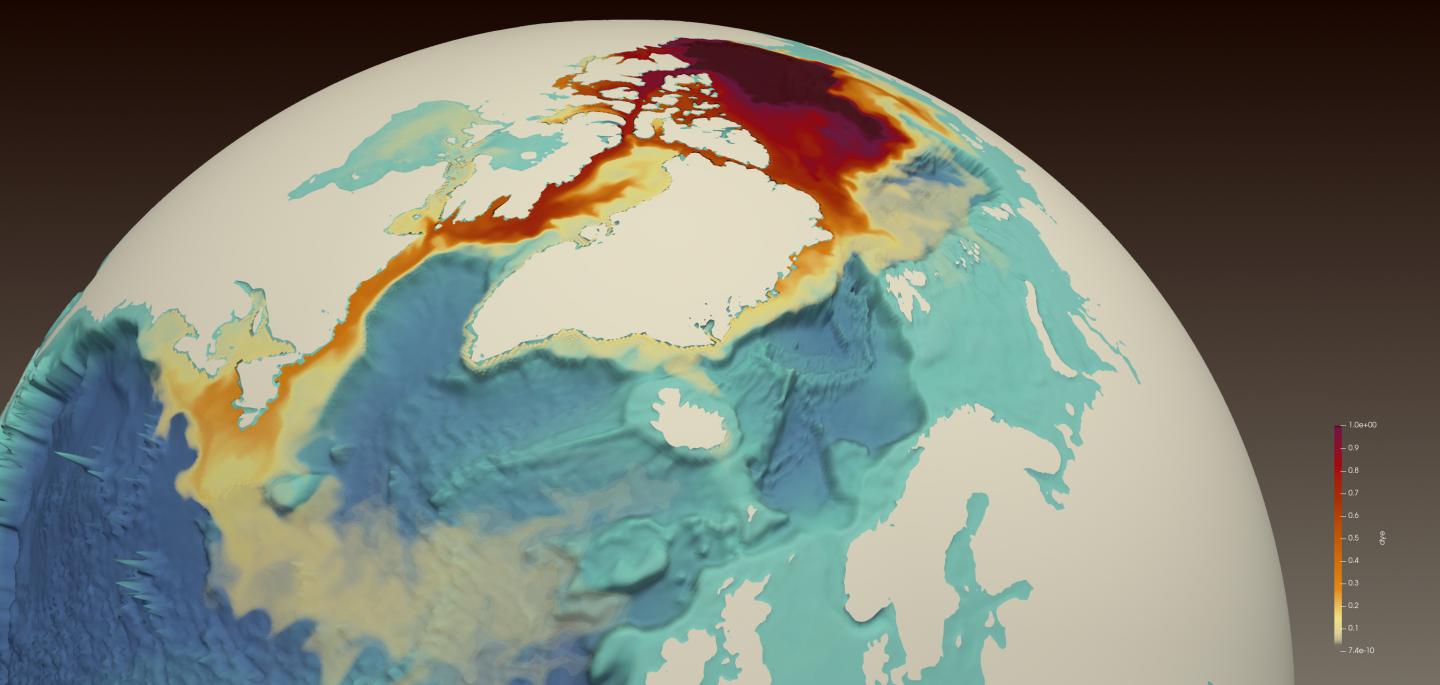
A new study shows that this freshwater travels through the Canadian Archipelago to reach the Labrador Sea, rather than through the wider marine passageways that connect to seas in Northern Europe. The open-access study was published in Nature Communications.

“The Canadian Archipelago is a major conduit between the Arctic and the North Atlantic,” said lead author Jiaxu Zhang, a UW postdoctoral researcher at the Cooperative Institute for Climate, Ocean and Ecosystem Studies. “In the future, if the winds get weaker and the freshwater gets released, there is a potential for this high amount of water to have a big influence in the Labrador Sea region.”

The finding has implications for the Labrador Sea marine environment, since Arctic water tends to be fresher but also rich in nutrients. This pathway also affects larger oceanic currents, namely a conveyor-belt circulation in the Atlantic Ocean in which colder, heavier water sinks in the North Atlantic and comes back along the surface as the Gulf Stream. Fresher, lighter water entering the Labrador Sea could slow that overturning circulation.

A simulated red dye tracer released from the Beaufort Gyre in the Artic Ocean (center top) shows freshwater transport through the Canadian Arctic Archipelago, along Baffin Island to the western Labrador Sea, off the coast of Newfoundland and Labrador, where it reduces surface salinity.

“We know that the Arctic Ocean has one of the biggest climate change signals,” said co-author Wei Cheng at the UW-based Cooperative Institute for Climate, Ocean and Atmosphere Studies. “Right now this freshwater is still trapped in the Arctic. But once it gets out, it can have a very large impact.”

Fresher water reaches the Arctic Ocean through rain, snow, rivers, inflows from the relatively fresher Pacific Ocean, as well as the recent melting of Arctic Ocean sea ice. Fresher, lighter water floats at the top, and clockwise winds in the Beaufort Sea push that lighter water together to create a dome.

When those winds relax, the dome will flatten and the freshwater gets released into the North Atlantic.

“People have already spent a lot of time studying why the Beaufort Sea freshwater has gotten so high in the past few decades,” said Zhang, who began the work at Los Alamos National Laboratory. “But they rarely care where the freshwater goes, and we think that’s a much more important problem.”

Using a technique Zhang developed to track ocean salinity, the researchers simulated the ocean circulation and followed the Beaufort Sea freshwater’s spread in a past event that occurred from 1983 to 1995.

Their experiment showed that most of the freshwater reached the Labrador Sea through the Canadian Archipelago, a complex set of narrow passages between Canada and Greenland. This region is poorly studied and was thought to be less important for freshwater flow than the much wider Fram Strait, which connects to the Northern European seas.

In the model, the 1983-1995 freshwater release traveled mostly along the North American route and significantly reduced the salinities in the Labrador Sea — a freshening of 0.2 parts per thousand on its shallower western edge, off the coast of Newfoundland and Labrador, and of 0.4 parts per thousand inside the Labrador Current.

The volume of freshwater now in the Beaufort Sea is about twice the size of the case studied, at more than 23,300 cubic kilometers, or more than 5,500 cubic miles. This volume of freshwater released into the North Atlantic could have significant effects. The exact impact is unknown. The study focused on past events, and current research is looking at where today’s freshwater buildup might end up and what changes it could trigger.

“A freshwater release of this size into the subpolar North Atlantic could impact a critical circulation pattern, called the Atlantic Meridional Overturning Circulation, which has a significant influence on Northern Hemisphere climate,” said co-author Wilbert Weijer at Los Alamos National Lab.

More information: https://www.nature.com/articles/s41467-021-21470-3

Climate change has reduced ocean mixing far more than expected

The ocean is dynamic in nature, playing a crucial role as a planetary thermostat that buffer global warming. However, in response to climate change, the ocean has generally become stabler over the past 50 years. Six times stabler, in fact, than previously estimated–as shown by a new study that researchers from the CNRS, Sorbonne University, and IFREMER have conducted within the scope of an international collaboration.* Warming waters, melting glaciers, and disrupted precipitation patterns have created an ocean surface layer cut off from the depths. Just as oil and water separate, so this division of surface and deeper waters limits oceanic mixing, making it harder for the ocean to mitigate climate change. Furthermore, climate change has strengthened winds, which has thickened the ocean surface layer by 5 to 10 m per decade over the last half century. This has hindered vital access to light for most marine organisms within it. Published in Nature, these findings underscore the consequences of climate change and anthropogenic phenomena for the ocean, the life it harbours, and its capacity to remain a global thermostat into the future.

This work calls for reconsideration of the drivers of ongoing shifts in marine primary production, and reveals stark changes in the world’s upper ocean over the past five decades.

More information: Sallée, JB., Pellichero, V., Akhoudas, C. et al. Summertime increases in upper-ocean stratification and mixed-layer depth. Nature 591, 592–598 (2021). https://doi.org/10.1038/s41586-021-03303-x

Are cold winters in Europe caused by melting sea-ice in the Arctic?

They are diligently stoking thousands of bonfires on the ground close to their crops, but the French winemakers are fighting a losing battle. An above-average warm spell at the end of March has been followed by days of extreme frost, destroying the vines with losses amounting to 90 percent above average. The image of the struggle may well be the most depressingly beautiful illustration of the complexities and unpredictability of global climate warming. It is also an agricultural disaster from Bordeaux to Champagne.

Nasa

It is the loss of the Arctic sea-ice due to climate warming that has, somewhat paradoxically, been implicated with severe cold and snowy mid-latitude winters.

“Climate change doesn’t always manifest in the most obvious ways. It’s easy to extrapolate models to show that winters are getting warmer and to forecast a virtually snow-free future in Europe, but our most recent study shows that is too simplistic. We should beware of making broad sweeping statements about the impacts of climate change.” Says professor Alun Hubbard from CAGE Center for Arctic Gas Hydrate, Environment and Climate at UiT The Arctic University of Norway.

Melting Arctic sea ice supplied 88% of the fresh snow

Hubbard is the co-author of a study in Nature Geoscience examining this counter-intuitive climatic paradox: A 50% reduction in Arctic sea-ice cover has increased open-water and winter evaporation to fuel more extreme snowfall further south across Europe.

The study, led by Dr. Hanna Bailey at the University of Oulu, Finland, has more specifically found that the long-term decline of Arctic sea-ice since the late 1970s had a direct comparison to one specific weather event: “Beast from the East”—the February snowfall that brought large parts of the European continent to a halt in 2018, causing £1bn a day in losses.

Researchers discovered that atmospheric vapor traveling south from the Arctic carried a unique geochemical fingerprint, revealing that its source was the warm, open-water surface of the Barents Sea, part of the Arctic Ocean between Norway, Russia, and Svalbard. They found that during the “Beast from the East,” open-water conditions in the Barents Sea supplied up to 88% of the corresponding fresh snow that fell over Europe.

Climate warming is lifting the lid off the Arctic Ocean

“What we’re finding is that sea-ice is effectively a lid on the ocean. And with its long-term reduction across the Arctic, we’re seeing increasing amounts of moisture enter the atmosphere during winter, which directly impacts our weather further south, causing extreme heavy snowfalls. It might seem counter-intuitive, but nature is complex and what happens in the Arctic doesn’t stay in the Arctic.” says Bailey.

When analyzing the long-term trends from 1979 onwards, researchers found that for every square meter of winter sea-ice lost from the Barents Sea, there was a corresponding 70 kg increase in the evaporation, moisture, and snow falling over Europe.

“This study illustrates that the abrupt changes being witnessed across the Arctic now, really are affecting the entire planet,” says professor Hubbard.

Their findings indicate that within the next 60 years, a predicted ice-free Barents Sea will likely become a significant source of increased winter precipitation—be it rain or snow—for Europe.

More information: Hannah Bailey et al, Arctic sea-ice loss fuels extreme European snowfall, Nature Geoscience (2021). DOI: 10.1038/s41561-021-00719-y

Provided by UiT The Arctic University of Norway

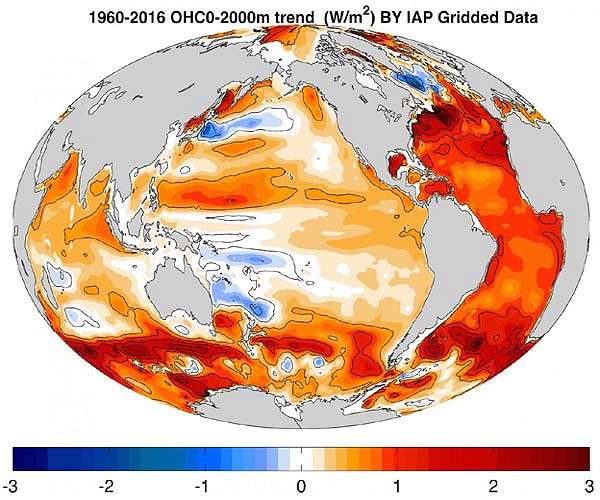
Scientists complete largest global assessment of ocean warming impacts

A group of international marine scientists has compiled the most comprehensive assessment of how ocean warming is affecting the mix of species in our oceans – and explained how some marine species manage to keep their cool.

Martin Edwards from the University of Plymouth along with other researchers from the UK, Japan, Australia, USA, Germany, Canada, South Africa and New Zealand analysed three million records of thousands of species from 200 ecological communities across the globe.

Reviewing data from 1985 – 2014, the team led by Michael Burrows of the Scottish Association for Marine Science (SAMS) in Oban showed how subtle changes in the movement of species that prefer cold-water or warm-water, in response to rising temperatures, made a big impact on the global picture. The findings, published in the journal Nature Climate Change [https://www.nature.com/articles/s41558-019-0631-5], show how warm-water species increase and cold-water marine species become less successful as the global temperature rises. However, the study also suggests that some cold-water species, and fish in particular, will continue to thrive by seeking refuge in cooler, deeper water.

Prof Burrows  further added:

“For the period from 1985 – 2014 we created the equivalent of an electoral poll in the ocean, showing swings between types of fish and plankton normally associated with either cold or warm habitats. As species increase in number and move into, or decline and leave, a particular ecological community, the make-up of that community will change in a predictable way. While this may not sound like a big change, it has a considerable impact on species that may already be on, or close to, their maximum temperature tolerance. A gradual temperature change like the one we are witnessing is not going to cause extinctions overnight but it is affecting the success of many species, not least zooplankton such as copepods, which are crucial to the ocean food web”.

Prof Edwards said the truly global study looked at data from the North Atlantic, Western Europe, Newfoundland and the Labrador Sea, east coast USA, the Gulf of Mexico, and the North Pacific from California to Alaska. While the global warming trend was widely seen, the North Atlantic showed the largest rise in average temperature during the time period. This area of the North Atlantic is routinely monitored by one of the world’s largest and longest marine biological surveys known as the Continuous Plankton Recorder (CPR) Survey which provided some key observational data in the global study. The changes observed have been driven by a seemingly small but ecologically significant rise in temperature of almost one degree Celsius in some parts of the ocean since 1985, a rapid change in just three decades. These changes are having huge implications for the abundance and distribution of plankton in our oceans.


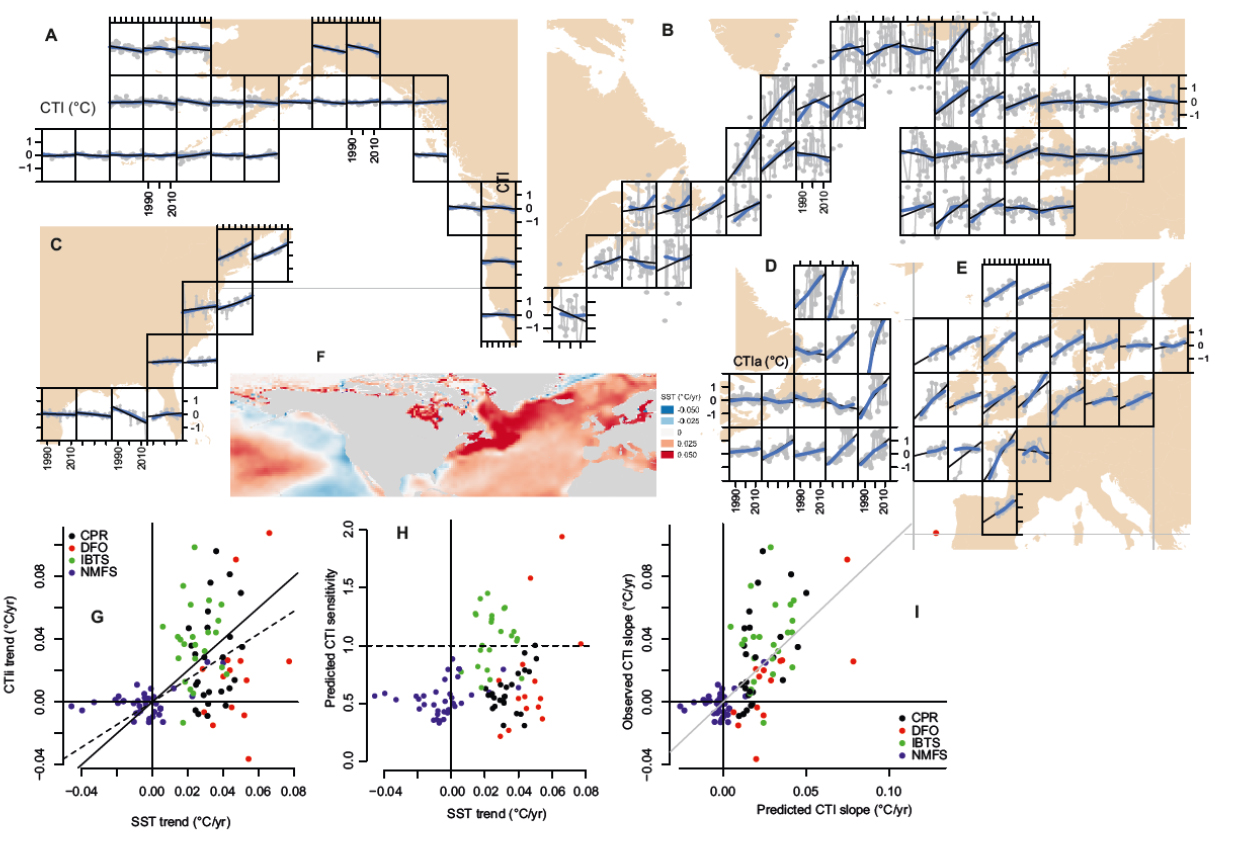
Climate-related changes in fish and plankton communities shown by changes in Community Temperature Index values from 1985 to 2015.

Plymouth scientists highlight effects of climate change on UK’s plankton

Marine scientists in Plymouth have led a major study highlighting the effects of climate change on the plankton populations in UK seas.

Published as part of a wide-ranging report by the Marine Climate Change Impacts Partnership (MCCIP), it shows there have been extensive changes in plankton ecosystems around the British Isles over the last 60 years.

It says climate variability and ocean warming have had negative impacts on plankton production, biodiversity and species distributions, which have in turn affected fisheries production and other marine life such as seabirds.

The study was written by world-leading researchers from the University of Plymouth and Plymouth Marine Laboratory, along with colleagues at Marine Scotland Science and the Centre for Environment Fisheries and Aquaculture Science.

It forms part of the MCCIP Report Card 2020, which summarises 26 individual, peer-reviewed scientific reports to provide detailed evidence of observed and projected climate change impacts and identify emerging issues and knowledge gaps.

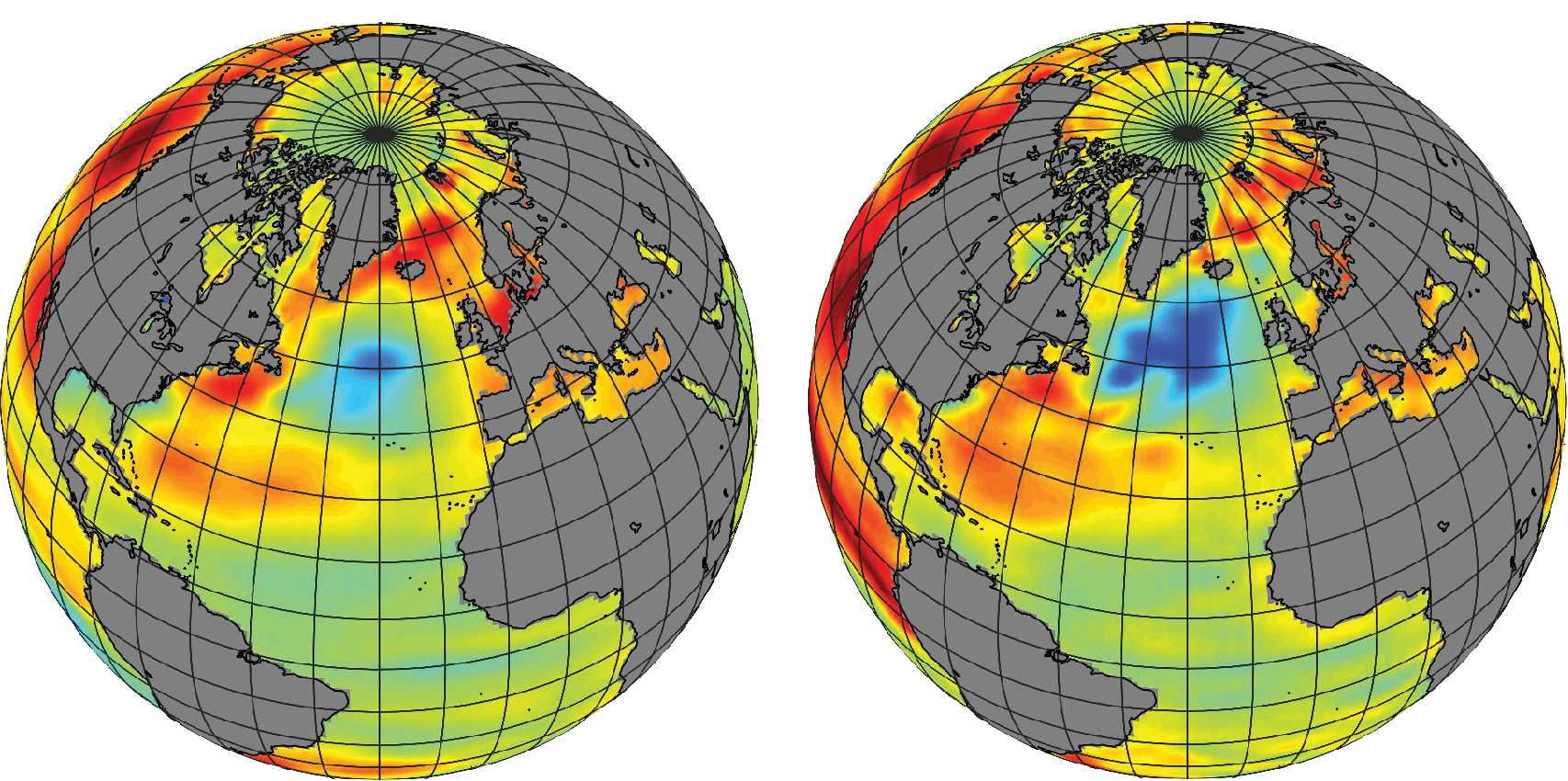
Emergence of a cold-water ‘blob’ in the North Atlantic sub-polar gyre region

Martin Edwards, Professor of Ocean Ecology at the University of Plymouth, led the report on plankton. He said:

“There have been extensive changes in plankton ecosystems around the British Isles over the last 60 years, mainly driven by climate variability and ocean warming. For example, during the last 50 years there has been a northerly movement of some warmer water plankton by 10° latitude in the North-east Atlantic and a similar retreat of colder water plankton. Future warming is likely to alter the geographical distribution of plankton abundance and these changes may place additional stress on already depleted fish stocks, as well as having consequences for mammal and seabird populations.”

Among the key factors highlighted in the plankton report are:

  • There has been a shift in the distribution of many plankton and fish species around the planet.
  • The North Sea populations of previously dominant and important zooplankton species (the cold water species Calanus finmarchicus, a major food source for fish, shrimp and whales) have declined in biomass by 70% since the 1960s.
  • Species with warmer-water affinities (e.g. Calanus helgolandicus) are moving northwards to replace the species, but are not as numerically abundant.
  • The decline of the European cod stocks due to overfishing may have been exacerbated by climate warming and climate-induced changes in plankton production.
  • Future warming is likely to alter the geographical distribution of primary and secondary open ocean (pelagic) production, affecting ecosystem services such as oxygen production and the removal of carbon dioxide from the atmosphere.

Get the report here:

Warming drives ‘fundamental’ changes to ocean.

Climate change has wrought major changes to ocean stability faster than previously thought, according to a recent study, raising alarms over its role as a global thermostat and the marine life it supports.

The research published in the journal Nature looked at 50 years of data and followed the way in which surface water “decouples” from the deeper ocean.

Climate change has disrupted ocean mixing, a process that helps store away most of the world’s excess heat and a significant proportion of CO2.

Water on the surface is warmer — and therefore less dense — than the water below, a contrast that is intensified by climate change.

Global warming is also causing massive amounts of fresh water to flush into the seas from melting ice sheets and glaciers, lowering the salinity of the upper layer and further reducing its density.

This increasing contrast between the density of the ocean layers makes mixing harder, so oxygen, heat and carbon are all less able to penetrate to the deep seas.

Long-term responses of North Atlantic calcifying plankton to climate change

Study on calcifying plankton and climate change published in Nature Climate Change

Abstract:

The global increase in atmospheric carbon dioxide concentration is potentially threatening marine biodiversity in two ways. First, carbon dioxide and other greenhouse gases accumulating in the atmosphere are causing global warming. Second, carbon dioxide is altering sea water chemistry, making the ocean more acidic.

Although temperature has a cardinal influence on all biological processes from the molecular to the ecosystem level, acidification might impair the process of calcification or exacerbate dissolution of calcifying organisms.

Here, we show however that North Atlantic calcifying plankton primarily responded to climate-induced changes in temperatures during the period 1960–2009, overriding the signal from the effects of ocean acidification. We provide evidence that foraminifers, coccolithophores, both pteropod and non-pteropod molluscs and echinoderms exhibited an abrupt shift circa 1996 at a time of a substantial increase in temperature and that some taxa exhibited a poleward movement in agreement with expected biogeographical changes under sea temperature warming. Although acidification may become a serious threat to marine calcifying organisms, our results suggest that over the study period the primary driver of North Atlantic calcifying plankton was oceanic temperature.

more information: https://www.nature.com/articles/nclimate1753